martes, 31 de enero de 2012

Making a Commedia del Arte Mask


Aim of Task: To learn about Commedia del Arte character masks, to know the characteristics of our specific character mas and to make the Commedia del Arte mask that corresponds to our character (Pantalone in my case).

Description of Task: First, we had to get an idea of what our character mask should look like. Therefore, we investigated about the characteristics in our masks and drew a sketch on a piece of paper. Pantalone, my character, almost always has thick eyebrows and a falic-like nose. I know his animal is a chicken, so it should have a lot of wrinkles in his face. Here is a picture of the sketch I did before starting the making of the mask:

First, we molded the mask with clay. We used a very hard, yet very mold-able, kind of clay. We had to use a lot of clay to make the details since Steve told us to "not be gentle" with characteristics. Therefore, we had to use a lot of clay to make the nose and the eyebrows. We used a cutter to leave space for the eyes. We had to put the clay in our faces to see if the size of the mask was adequate and keep on asking our peers how could we improve the mask according to our face. After we were done doing the mold, we took it outside to the roof to put it somewhere were the mold could receive sunlight and dry. We left it there for a whole day for it to dry

After we had the mold, we used cotton and polyester cloth to make the mask. To paste the cloth to the mask we used a mixture of water and glue. To make sure the mask will end hard enough, put three layers of cloth on top. Cutting the cloth and pasting it was a thorough activity. We had to make sure that the cloth was in the edges of each characteristic in the mask, so there would be no problems when the cloth hardens. After finishing putting the three layers of cloth, we let the masks dry for another day.

After letting them dry, we used paintbrushes to paint the masks. Pantalone usually uses a dark color so I decided to paint the mask in a dark gray paint and use light gray paint to emphasize the characteristics like eyebrows and lips.


The final result was very different from the sketch. Using light gray in the mask really helped emphasizing the characteristics but the mask was too long; it's difficult to use the clay mold to shape it to the size of your head.

Reflection: Next time, in order to make a clay mold that would more accurately fit my face, I could make a paper shape that shapes my face to put the clay on it. The nose could have been bigger to exaggerate the characteristics in commedia. Also, the nose ended positioned over my mouth, which obstructs my voice when I am speaking. Bigger wholes for the eyes would have been better also to have a better view through the mask.

Conclusion: Making a commedia del arte mask can be lengthy process. There is different characteristics in different commedia del arte characters that must be emphasized in masks. Now that we have made the first mask, if we have to do a second mask we can use difference things to enhance it like draw a shape of our face before in paper so we can put it on top of the clay.

Designing Mask: Pantalone

Aim of Task: To make a mask design on Pantalone so we can later use it to design the mask.

Description of Task:In an A4 or double-A4 sheet of paper, we drew the design of a the mask of our character so we could further develop it to a mask. I looked for images of "pantalone" mask on google and found several masks: most of them very wide and in dark colors like black, brown, etc. A common characteristic on most of the masks, was very wide eyebrows and big nose. The description that the book "Commedia dell' Arte: An actor's handbook" did about the mask was "Long, hooked nose with bushy eyebrows, sometimes also a moustache. Pointed beard just forward as if to meet the nose coming down, thus giving a very dynamic profile".

While designing the mask I tried to emphasize the "hooked nose" aspect and very large eyebrows. Many of the masks that I saw on Google images had hairy eyebrows but since I didn't have anything to make the eyebrows specifically hairy, I drew the design with eyebrows of rough texture so I could later do it on the mask. This is the final result of the design:


Reflection:It is important that the mask that each of the characters in Commedia dell' Arte wear a mask with consistent characteristics so the audience can associate each mask with the personality of each character and the things that they commonly do. It is important to make a mask design before making the mask to be sure to have a mental image of the final product of the mask.

Conclusion:Commedia dell' Arte largely relies on a consistent image of different characters throughout different scenes. This is why the designing of a mask according to the character's personality is important, so that the audience can identify it in different plays.

martes, 10 de enero de 2012

Back from Holidays: Status Exercises

Aim of Task: To recall what we had done before holidays. Remember the concept of status on stage.

Description of Task: After greeting us for new years and holidays, Steve took a deck of cards, shuffled it and asked for two volunteers. He gave a card nobody else saw to each one of them. The lowest value the card had, the highest status this person was going to play. In that sense, Ace would mean the highest status possible and King the lowest status possible. After giving the cards to the two volunteers he asked each one of them to walk from opposite sides of the room to the other side; using the status they had in the card. The rest of the class had to guess. It was interesting to notice who had a highest status from the two. However, in some cases, like when one person had a 5 and the other one 6, it was very difficult to guess because the status was almost the same. It was a good exercise to remember the basic characteristics about high and low status though; high status: careless, confident; low status: emotion showing, rejected, defensive body posture.


After that, we all sit in a circle. Two people went up in the middle on the circle and started improvising a scene. One of them played a high status character and the other one played a low status character. Then, whenever somebody in the circle felt like it, he would say "stop" and take the place of one of the two actors. However, this person had to change the character so if it was a low status character, it would change to high status and if it was a high status character, it would change to low status. This helped create different scenes with different characters who showed different statuses.


Reflection: When somebody changed character with someone else, he had to take the position of a character that is higher status in society. For example, if the other character was a student, the person would take the teacher character which is a person of higher status/authority in society. Other characters that students in our class took as high status characters were business owners, security guards and policemen. I think that there is certain positions of people we see daily that have authority and normally hold a high status in everyday life.

Conclusion: Normally authority plays a great role in status. Somebody who has authority can implicitly demand more from the other people around him. When acting somebody of authority during a play, a high status should be taken into account.

viernes, 16 de diciembre de 2011

Status


Aim of Task: To learn about the status handled on stage to further apply it to Comedia performances.

Description of Task:
Our teacher, Steve, asked us to group ourselves in couples. Each one of us had a pair, mine was Jason. He told us that one of us would be the master and one would be the servant. The master would first tell his servant what he had to do and all the servant had to do was follow orders. I tried to make the exercise interesting and tell Jason to do funny things, like flirt with other people in the classroom. Then Steve told us that the servant should reply "yes master" to everything the master said. So for every command that I gave to Jason, Jason would have to reply "yes master." It was nice to feel that your orders were received in such a pleasant way, and obeyed without complaints. After that, the servants not only had to reply "yes master" to everything but also had to give a suggestion to the order that the master gave to them. For example, if I asked Jason to draw a dog in the board he would say "yes master, but, wouldn't it be better if I drew a cat instead?" As a master, this started to become a little bit annoying because it didn't feel like my orders were always followed unconditionally. Then I had to become the servant to Jason. Jason started asking me to do lots of stuff, and after a while, I also started replying yes master and then yes master and offer a suggestion as he had done with me. I felt that perhaps I wasn't saying "yes master" as eagerly as I should have said it considering that he was my master. Then, I tried to suggest things but it didn't feel good when he would deny my suggestions and I always had to do what he said. I felt inferior to him, he was in charge of my actions, I wasn't. After the master and servant exercise, we did something similar to what we had done in a previous workshop. In pairs, and in different exercises, each one of us had to:
  • Raise our status and lower the other person's status.
  • Raise the other person's status.

We did this in conversations. To raise the other person's status the most effective thing was to give them compliments and show amazement for everything they said about themselves. However, to raise your own status, and lower the other person status, you had to say why everything you did was better than what the other person did. It was a fun exercise, in my opinion.

The last exercise that we had to do was a script that was given to us. We had to try it with different combinations between low and high status between the two characters. I noticed that when both people hold low status, the acting turns less interesting and boring. When both people had high status, it wasn't too boring but it also wasn't as entertaining as seeing somebody with high status and somebody with low status.

I really liked the way Prodhi and Adam presented the extract. Prodhi showed high status while Adam showed low status. To show high status, Prodhi put one of her legs on the chair and started talking to Adam, who was seated. Prodhi's voice was a lot more eloquent and loud than Adam's voice. Also, Adam almost fled from stage at the end of the extract.

Reflection: Status is show by the tone of voice, body expressions, posture, attitude towards other characters in stage... I think status is how concerned is the character of what other actors do. A high status character will not care about other characters on stage while a low status character will be so worried about his actions that he will always be aware of how his actions can affect other people on stage.

Conclusion: Status will be very useful for comedia: some combinations of status can turn out to be really funny like both characters with low status or both characters with high status. Since I first heard about status, I have been interested on its applications to our daily social life. Status is something that can be seen everyday in social situations, which is why I find it so interesting. I hope to learn more about it through the theatre course although I've already been reading something about it. It is probably one of the theatre techniques I'm mostly interested in.

lunes, 12 de diciembre de 2011

Commedia dell' Arte: Presentation and Wax Museum


Aim of Task: To share our knowledge about Commedia dell' Arte characters with our partners and with the whole class.

Description of Task: Following the previous research we did on our partner's Commedia dell' arte chosen character, we did a presentation for them where we told them personally all the facts that we found about their character. I told my partner, Shari, all I found out about Isabella: the gestures she normally uses, the custome, her relationship with other characters and with the audience... I tried to put more detail and emphasis more the things I thought she would be more interested in and could have got her attention when talking to her.

After this, she made her presentation about Flavio to me: she also talked to me mostly about his characteristics and his performance on stage.

After we were done with presenting our characters to each other, our teacher, Steve, asked us what were some of the good techniques in presenting. One of my classmates said that when her partner did her presentation, she compared La Ruffiana to Snowhite's old lady. I thought that was a pretty good way of giving an example people can relate to and are familiar with. It is definitely something I can include in my next research.

After we were done with feedback, we started doing what we called the "wax museum." Half of the class left the classroom and the other half stayed with their pairs. The half that stayed in the room, one person in each couple molded the other person into a position that was characterstical of their character. Then, that person had to stay still in that position while the other half of the classroom came in and the partner who was not standing still from the couple would give an oral presentation of who this character was and what was his personality/characteristics. After that, each couple would switch partners, give the presentation in the same manner, and after that the second half of the class would do the same thing.

It was quite an interesting exercise to imagine being in a museum where there was several people greeting you and telling you random information about that person who was standing still. I liked it a lot!

Reflection: What we did today in class was a very effective way of sharing information. It was an excellent class teamwork to research different things and the present that to our other classmates. This is how we can learn by sharing with other people. This is actually related to TOK and one of the forms of knowing: by other people.

Conclusion: I am very convinced Pantalone is the character I want to play now. Flavio was not really the character for me, I don't think I will really enjoy playing him. However, Pantalone seems to fit a lot of characteristics that I find funny and interesting to include while acting. Pantalone will be the primary choice for my Commedia dell' Arte performance.

jueves, 8 de diciembre de 2011

Commedia dell' Arte: Isabella Investigation


Name of character (and its origins): Isabella. This character is immediately associated with Isabella Andreini (1562-1604). She was admired through France and Italy by all classes. She was a very well educated poet and a songwriter too.

Status (class of character): Prima donna, innamorata (lover). Daughter of Pantalone. Flirtatious and stubborn, men often fall in love with her.

Physicality:

  • Stance: she is rarely standing in both feet: normally making ballet positions. Chest full of breath.

  • Animal characteristics: pink flaming, love bird.

  • Walk: swishing and swinging around, wobbling.

  • Gestures: often holding flowers or handkerchiefs.

  • Other: exaggerated movements of the hands.

Voice (vocal characteristics): refined and unpretentious.

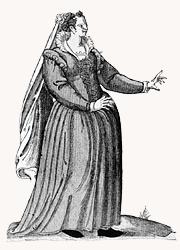
Costume: uses a long dress, often holding a handkerchief, a fan or a book (see attached images).

Mask: no physical mask but often uses a lot of makeup.

Props: handkerchief, fan or book.

Relationships (to other characters and audience): lovers are more in love with the idea of being in love than with themselves. She is extremely aware of being watched by the audience and often flirts with spectators.

Plot/stage function: a lover, although she initiates solutions to her own account most of the time.

Characteristics/persona/other: A little bit proud, extremely dramatic. Has independent will and she is highly cultivated. As the other lovers, she is self-obsessed and selfish. They are more interested in what they are saying and how it sounds than what their beloved is saying.

Think of(anything that will help the actor to access the character): As a lover, Isabella should be very playful, flirtatious. She should be the woman desired by plenty of man: playful but at the same time confident.


Source Page

"Commedia Stock Characters Isabella." Shane Arts Home Page. N.p., n.d. Web. 8 Dec. 2011. .

Delpiano, Roberto. "Isabella." Roberto Delpiano's website . N.p., n.d. Web. 8 Dec. 2011. .

Rudlin, John. Commedia dell'arte an actor's handbook. London: Routledge, 1994. Print.

martes, 6 de diciembre de 2011

Commedia dell' Arte: Characters

Commedia dell' Arte Characters

When reading the information sheet, there are some characters that immediately capture my attention:
  • Pantalone:

He is a short character. He is a character whose orders have to be obeyed because he has money. Uses tight trousers, sleepers and a tight fitting jacket. I don't think I would meet the physical appearance of Pantalone. And I wouldn't enjoy to play a high status character as comical.

  • IL Capitano:

This character often pretends high status. A coward. Stops everywhere to show the audience that he should be admired. I don't think I will be able to relate very well to this character and it doens't seem as comical to me to perform it.

  • Arlecchino:

He is usually a servant to Pantalone. He is a character that can be, by his costume, considered funny by ridiculization. He is normally physically quick but mentally slow. He constantly speaks. I think that would be something I would enjoy to do considering that I have seen myself in that situation!

I think Arlecchino is the character that appeals to me the most and I would like to play it on our Commedia dell' Arte performance next term.