sábado, 25 de febrero de 2012

Performance of the cannovacci to Steve


Aim of Task: To perform all of what we have in the cannovacci to Steve so that he can give us feedback on what we have done and make the performance better before we present it.

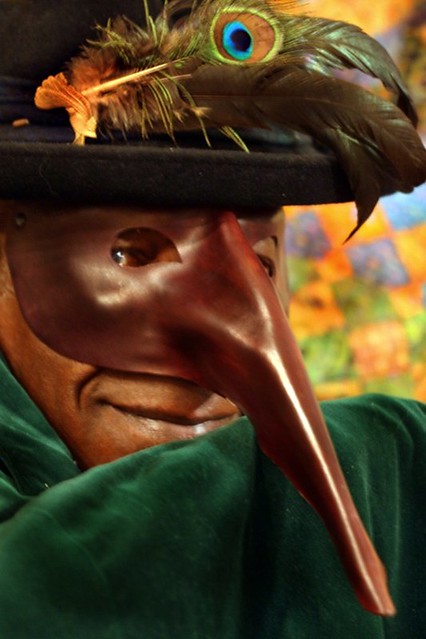
Description of Task: After we presented our cannovacci to Steve he told us the play still need some work before it was ready to be presented on stage; which I agree on. Steve mentioned a lot of good things we had done including the fact that Zanni's performance was very good. Then, he told some of us that we were not facing the audience enough. He thinks I need to enunciate my words more. I have a problem with my mask because it's nose covers a big part of my mouth which obstructs whatever I say. However, to make that better, I need to make low-pitched voices so the audience can hear it better and I also need to open my mouth wider whenever I speak. A low-pitch voice is characteristic of Pantalone because his animal is the chicken, a very low-pitch sound animal. Another thing that I really need to improve too, and that Steve mentioned, is that I commonly look down when I am acting; I need to put the mask a little bit more up, at the level of the audience, so the mask can face the audience when I am speaking.

My group and I will keep on meeting so that we can finalize the play and make it ready to present to Sha Tin College.

Reflection: There is still work we have to do on the play. Although we have rehearsed it, there is still some things that sometimes do not make quite much sense. We will keep working on it.

Conclusion: It is always good to have an external opinion, and opinion from somebody who is not in the actors so that these person can tell the actors what goes well and what doesn't. This is what normally a director is for, but since we are not having directors in any of our groups we are not able to do that. I do not know if directors are common in Commedia dell' Arte performances but I think they would definitely be useful for us.

viernes, 24 de febrero de 2012

Practicing what we have of the Cannovacci so far


Aim of Task: To start actually rehearsing the scenes in the cannovacci that we have been discussing. To think about the scenes that will go in between the scenes we already have and complete the cannovacci.

Description of Task: Now that we have a better idea of what our cannovacci is going to look like, we will be rehearsing the scenes that we have thought about. In the process of rehearsing, we expect to think about the scenes that will go in between the scenes we have already thought about.

Pantalone is an old man. He doesn't walk straight, he walks with his back curved and speaks with a very rough voice. He is pretty much careless too, he cares almost only about money; nothing else. His animal is a chicken, so it is very important to make small fast movements. He walks in small, fast steps. His face is also always moving, looking around.

While performing, we figured that Pantalone will hit Zanni in the first scene to establish the servant-boss relationship. We also thought that Isabella should be the kind of girl that constantly asks her father things and constantly demands attention. Therefore, in the first scene. Isabella would be trying to talk with Pantalone but Pantalone would constantly interrupt her.

We also thought that one way we can explain how the characters fall asleep is that they are at a party, and after drinking a lot they fall to the ground and fall asleep. In this party we will play with words and the meaning of "melons." Pantalone will ask his servants to "bring the melons" and while Zanni will bring actual melons, Pantalone will reject them and demand that Colombina brings the melons.

After the scene where all characters realize that it will be the end of the world, IL Dotore will perform a "FBI - full body inspection" to Colombina, Zanni and IL Capitano which will be necessary for the to go to heaven. However, IL Dotore's main purpose will be to get to "inspect" Colombina. Nevertheless, Colombina tricks IL Dotore while his eyes are bended into touching La Ruffiana instead of her; which la Ruffiana really likes but then shouts at IL Dotore when IL Dotore makes a bad commentary about her body.

Reflection: Writing and discussing the cannovacci is one thing but actually starting to perform it gives you a better idea of what the cannovacci is about and helps you think better about it. Getting into your Commedia dell' Arte character is being an specific set of movements that are characteristic of your character.

Conclusion: There is still plenty of work we have to do in our cannovacci so that we can present it on stage. This will be our first performance as a theater year 1 group and we should make good first performance to all the school. I like Commedia dell' Arte because it is about making people laugh, I find it very curious to see how each character has its own way of being funny. It's fun to put this characters in different situations and letting them be funny by their own characteristics.

I think that commedia to some extent can explain why some stories are funny. Sometimes, I hear somebody telling a story about a person "x" they know and has a very specific characteristic say, this person never thinks twice what he says. Then when this somebody tells a story which demonstrates that "x" didn't think twice what he said and it was funny; the fact that the story reinforces the characteristic of "x" makes it even funnier. This is the case with commedia, characters do the same actions over and over again and that repetition and a very interesting humor factor that the audience can identify with.

Creating a Cannovacci, continued...

Description of Task: After discussing for some days what our Cannovacci is going to be about, we decided to write everything in paper.

In the first scene we will have Zanni picking up a newspaper that says in big letters that the world was going to end. We had some difficulties deciding on whether Zanni should read the newspaper or just lift it up so the audience could read it, but we decided that he would just let the audience read it because his character is not supposed to be "smart enough" to read out loud. He would only figure out that the news paper says the world is going to end by the pictures on the newspaper.

After that, Pantalone and Isabella will come in. Pantalone will be talking about money and call Isabella his daughter, to expose Pantalone's desire for money and the relationship between Pantalone and Isabella.

After coming in, Pantalone will turn on the radio and the announcer of the radio, who is going to be interpreted by Arshia, will say that the world is ending. This will serve as an additional cue to the audience of the theme of the play, the apocalypse.

After that scene, the second exposition scene will happen, where IL Dotore is at the market. IL Capitano will come in and ask IL Dotore for an "enlargement potion." This will show IL Dotore's character as the doctor he is and IL Capitano as the amazing lover he thinks he is. After IL Dotore and IL Capitano are talking about it, Zanni will come in and tell them about the about what he saw and heard in the news about the apocalypse. This will end up the exposition of the theme. Zanni will be the one who spreads the "news about the apocalypse."

After that, we are not sure about what scene to include after but we know the characters are going to fall asleep, and after they all fall asleep each of the characters will try to make his "ideal dream" come true before the world ends. For these, we have a scene where IL Capitano and Isabella will participate. Isabella will be looking for clothes to wear to see Flavio for the last moments when IL Capitano will come in and tell her how much he likes her and wants to be with her. While this scene is going on, La Ruffiana, Colombina and Zanni will be "looking through the keyhole" trying to figure out what is going on. IL Dotore and Pantalone will come in and talk about Pantalone giving his daughter to IL Dotore in exchange of access to heaven.

While IL Capitano will try to hide from Pantalone he will pretend to be a chair. Pantalone will try to sit in the chair but will notice a small "pin." Humor will rely on Pantalone saying how small the pin is. After that IL Capitano and Pantalone will have a fight where IL Capitano tries to be very courageous but ends up acting as a coward.

There will be a scene where all the characters notice it is the end of the world and they start laughing at something. Pantalone has a heart attack because he realizes his money is useless in heaven.

Reflection: It is difficult to put a Cannovacci together. Specially when there is several people, with several ideas, trying to put everything together. Putting all of our ideas together in a single Cannovacci can be a difficult job, as we have studied in TOK. It is important to include humor constantly in Commedia because, in the end, that is the focus of this type of Theater, to make the audience laugh. Commedia dell' Arte highly relies on improvisation. However from my experience with my group, it is difficult to agree in a sound story for a cannovaci. I noticed that on the previous exercises where we had a director, conflicts between the group where less common because the director is the one who makes all of the decisions. I don't know if it is common to do Commedia dell' Arte with a director, but I think it might be a lot of help when creating cannovacci.

Conclusion: The focus of Commedia dell' Arte should be humor and it is important to include physical humor in each scene. Theatre teaches you a lot of team work, it teaches you a lot on how to share ideas with each other and reach agreements between each other. It is something very useful in various aspects of life, this is something that I really wanted from this course and I am starting to realize how much I've learned about it!

miércoles, 22 de febrero de 2012

Creating a cannovacci


Aim of Task: To create our first Commedia dell' Arte Cannovacci. To know how the Cannovacci's in Commedia dell' Arte work. To start performing in our characters.

Description of Task: The whole class was divided in three groups. Each group will develop a Cannovacci that we will later present on stage, in public. Our group is conformed by Zanni, IL Dotore, IL Capitano, Isabella, Colombina and Pantalone. My character is Pantalone. As a group, we started brainstorming on what could we do as the main theme of our Cannovacci. We started brainstorming about a lot of things: dreams, parties, end of the world... We were not sure on what theme to choose but after thinking about the movie "inception" we decided that it would be a good idea to combine the idea of the apocalypse, the end of the world in 2012 according to the Mayans and the concept of dreams. We started brainstorming on how to combine these two themes in a single Cannovacci. The Apocalypse theme is rather unreal, so we decided that it would be good to include it as part of a dream. We could make the whole apocalypse and the world ending thing as part of the dreams of the characters in the Cannovacci.

After we had a theme, we started thinking about the exposition, which should be the part of the Cannovacci that goes first and is responsible of exposing the characters, it's relationships with each other and the setting. For the exposition, La Ruffiana is going to come in, giving a brief introduction of the plot, setting and characters. After, we will have Zanni in Pantalone's house. Then, Pantalone and Isabella will come in, with Pantalone referring to Isabella as his daughter and referring to Zanni as his servant. Pantalone could be talking about something like his bussinesses making money since it is a very common topic for Pantalone.

Another scene we could include is a market scene, with IL Dotore. In the market scene, IL Dotore will be selling his merchandise to Zanni or one of Pantalone's servants. That would present IL Dotore as potion-selling doctor he is in many of the Cannovacci's. IL Capitano will be included in scenes with Isabella. Since there is no Flavio in our play, IL Capitano would play as the lover of Isabella.

Most of the comedy in the play will rely on Zanni's dumbness, silliness and inability to express himself in complete words. Zanni is a dumb servant, in our Cannovacci he will not speak at all. The only thing he does is run around and make yelling sounds like if he was trying to speak. Zanni is great to make people laugh with his very uncontrolled movements. The first scene will have Zanni and Pantalone in it, and Pantalone will push him

Reflection: While we were discussing all of these things in the group, it was very difficult to agree on something. All of us had several ideas but it was difficult to choose which ones to include and which ones we shouldn't include. As a non-native English speaker, I also found it sometimes difficult to express my ideas fully to all the group. It took us a long time to discuss and actually agree on our theme, I think it may be one of the most difficult parts of creating a cannovacci. After this, we will start building upon the ideas we already have to create the specifics of the Cannovacci.

Conclusion: Now that we have the topic of our Cannovacci, we need to start talking about the specific scenes and lines. We need to think about specific things that will make up the comedy in the Cannovacci.

martes, 31 de enero de 2012

Making a Commedia del Arte Mask


Aim of Task: To learn about Commedia del Arte character masks, to know the characteristics of our specific character mas and to make the Commedia del Arte mask that corresponds to our character (Pantalone in my case).

Description of Task: First, we had to get an idea of what our character mask should look like. Therefore, we investigated about the characteristics in our masks and drew a sketch on a piece of paper. Pantalone, my character, almost always has thick eyebrows and a falic-like nose. I know his animal is a chicken, so it should have a lot of wrinkles in his face. Here is a picture of the sketch I did before starting the making of the mask:

First, we molded the mask with clay. We used a very hard, yet very mold-able, kind of clay. We had to use a lot of clay to make the details since Steve told us to "not be gentle" with characteristics. Therefore, we had to use a lot of clay to make the nose and the eyebrows. We used a cutter to leave space for the eyes. We had to put the clay in our faces to see if the size of the mask was adequate and keep on asking our peers how could we improve the mask according to our face. After we were done doing the mold, we took it outside to the roof to put it somewhere were the mold could receive sunlight and dry. We left it there for a whole day for it to dry

After we had the mold, we used cotton and polyester cloth to make the mask. To paste the cloth to the mask we used a mixture of water and glue. To make sure the mask will end hard enough, put three layers of cloth on top. Cutting the cloth and pasting it was a thorough activity. We had to make sure that the cloth was in the edges of each characteristic in the mask, so there would be no problems when the cloth hardens. After finishing putting the three layers of cloth, we let the masks dry for another day.

After letting them dry, we used paintbrushes to paint the masks. Pantalone usually uses a dark color so I decided to paint the mask in a dark gray paint and use light gray paint to emphasize the characteristics like eyebrows and lips.


The final result was very different from the sketch. Using light gray in the mask really helped emphasizing the characteristics but the mask was too long; it's difficult to use the clay mold to shape it to the size of your head.

Reflection: Next time, in order to make a clay mold that would more accurately fit my face, I could make a paper shape that shapes my face to put the clay on it. The nose could have been bigger to exaggerate the characteristics in commedia. Also, the nose ended positioned over my mouth, which obstructs my voice when I am speaking. Bigger wholes for the eyes would have been better also to have a better view through the mask.

Conclusion: Making a commedia del arte mask can be lengthy process. There is different characteristics in different commedia del arte characters that must be emphasized in masks. Now that we have made the first mask, if we have to do a second mask we can use difference things to enhance it like draw a shape of our face before in paper so we can put it on top of the clay.

Designing Mask: Pantalone

Aim of Task: To make a mask design on Pantalone so we can later use it to design the mask.

Description of Task:In an A4 or double-A4 sheet of paper, we drew the design of a the mask of our character so we could further develop it to a mask. I looked for images of "pantalone" mask on google and found several masks: most of them very wide and in dark colors like black, brown, etc. A common characteristic on most of the masks, was very wide eyebrows and big nose. The description that the book "Commedia dell' Arte: An actor's handbook" did about the mask was "Long, hooked nose with bushy eyebrows, sometimes also a moustache. Pointed beard just forward as if to meet the nose coming down, thus giving a very dynamic profile".

While designing the mask I tried to emphasize the "hooked nose" aspect and very large eyebrows. Many of the masks that I saw on Google images had hairy eyebrows but since I didn't have anything to make the eyebrows specifically hairy, I drew the design with eyebrows of rough texture so I could later do it on the mask. This is the final result of the design:


Reflection:It is important that the mask that each of the characters in Commedia dell' Arte wear a mask with consistent characteristics so the audience can associate each mask with the personality of each character and the things that they commonly do. It is important to make a mask design before making the mask to be sure to have a mental image of the final product of the mask.

Conclusion:Commedia dell' Arte largely relies on a consistent image of different characters throughout different scenes. This is why the designing of a mask according to the character's personality is important, so that the audience can identify it in different plays.

martes, 10 de enero de 2012

Back from Holidays: Status Exercises

Aim of Task: To recall what we had done before holidays. Remember the concept of status on stage.

Description of Task: After greeting us for new years and holidays, Steve took a deck of cards, shuffled it and asked for two volunteers. He gave a card nobody else saw to each one of them. The lowest value the card had, the highest status this person was going to play. In that sense, Ace would mean the highest status possible and King the lowest status possible. After giving the cards to the two volunteers he asked each one of them to walk from opposite sides of the room to the other side; using the status they had in the card. The rest of the class had to guess. It was interesting to notice who had a highest status from the two. However, in some cases, like when one person had a 5 and the other one 6, it was very difficult to guess because the status was almost the same. It was a good exercise to remember the basic characteristics about high and low status though; high status: careless, confident; low status: emotion showing, rejected, defensive body posture.


After that, we all sit in a circle. Two people went up in the middle on the circle and started improvising a scene. One of them played a high status character and the other one played a low status character. Then, whenever somebody in the circle felt like it, he would say "stop" and take the place of one of the two actors. However, this person had to change the character so if it was a low status character, it would change to high status and if it was a high status character, it would change to low status. This helped create different scenes with different characters who showed different statuses.


Reflection: When somebody changed character with someone else, he had to take the position of a character that is higher status in society. For example, if the other character was a student, the person would take the teacher character which is a person of higher status/authority in society. Other characters that students in our class took as high status characters were business owners, security guards and policemen. I think that there is certain positions of people we see daily that have authority and normally hold a high status in everyday life.

Conclusion: Normally authority plays a great role in status. Somebody who has authority can implicitly demand more from the other people around him. When acting somebody of authority during a play, a high status should be taken into account.